4,000
recruiting emails read and sorted
Every recruiting email is read, the details lifted out of the prose and filed to the right player. You just open the board.
No signup — password
Every prospect on your radar, in one place.
Sample datathe real one is your inbox
A recruiting inbox is not a pipeline. It is a pile — and the only thing standing between a prospect and being forgotten is whether somebody had time to type her into a spreadsheet.
The player writes. Then her mom writes. Then her club coach sends a roster with her buried on line nine.
Class year, position, hometown, travel team and a film link — scattered across a paragraph, never a field.
Anything nobody hand-enters is gone by August. The spreadsheet is only ever as current as your last free hour.
Point it at your recruiting inbox and leave it alone. No forwarding rule, no plugin, no change to how anybody emails you — and nothing for your staff to remember to do.
Player or parent or club coach, it works out who the message is actually about and lifts the details out of the paragraph — class year, positions, hometown, travel team, GPA, contact, film links.
Tier her High, Medium, Low or No Chance. Mark a visit, a camp invite, or both. Leave a note. The board reorders around what you decided — that part was always going to be yours.
Sort by tier, class or last contact. Filter to a position, a class, or just the portal.
Plain-English questions, answered from your own board — with her card beside the answer.
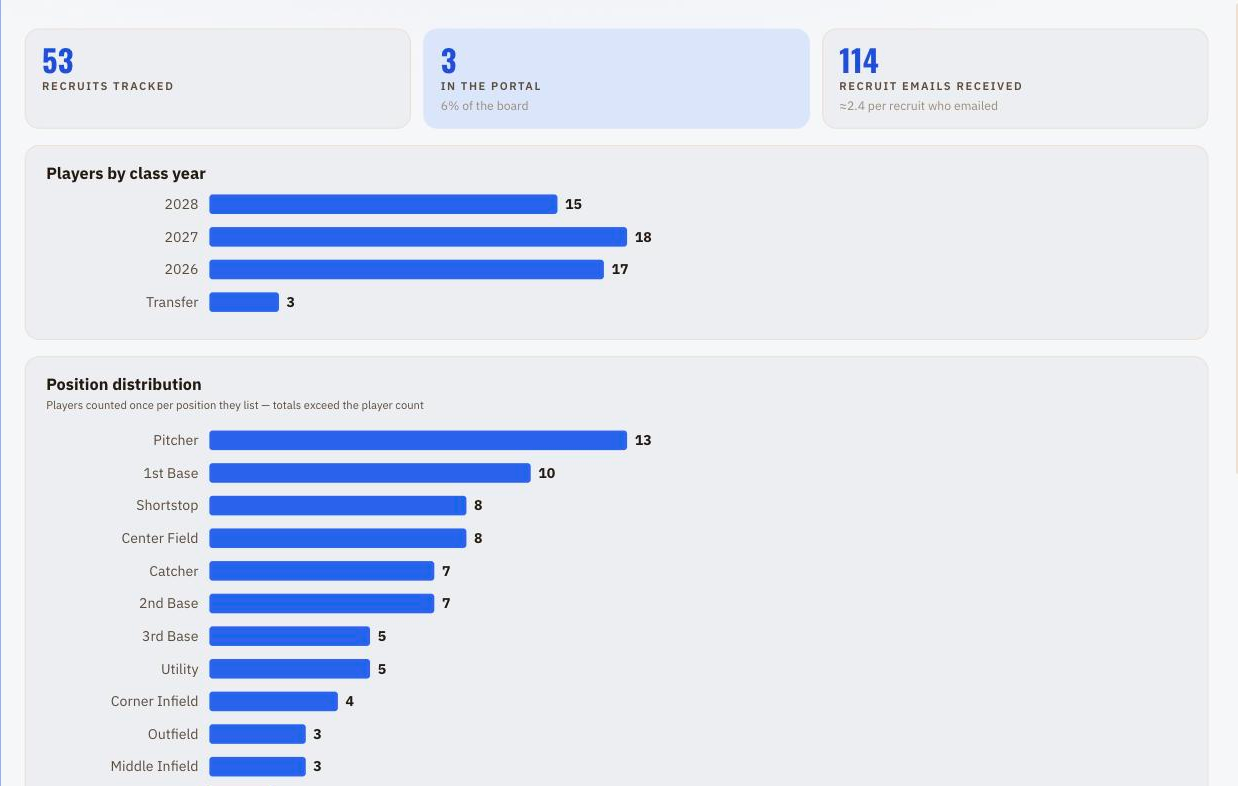
How many you’re tracking, how many are in the portal, and where the class and position gaps are.
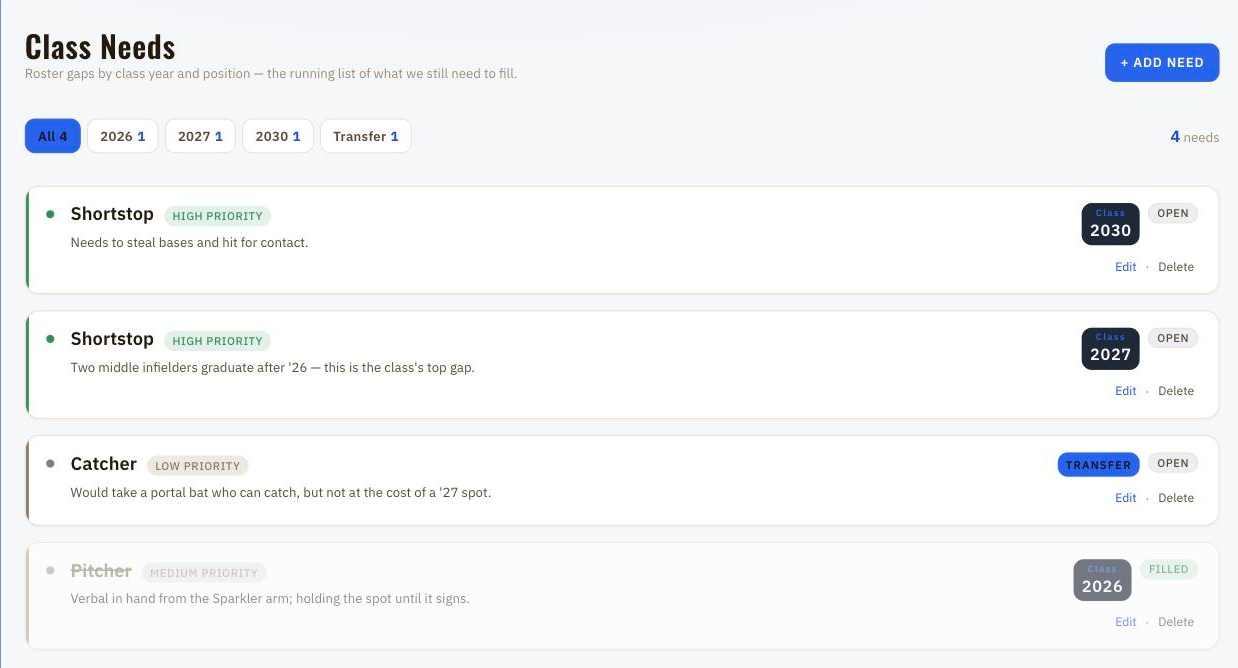
The roster gaps you’re actually recruiting to, by class and position, marked off as they fill.
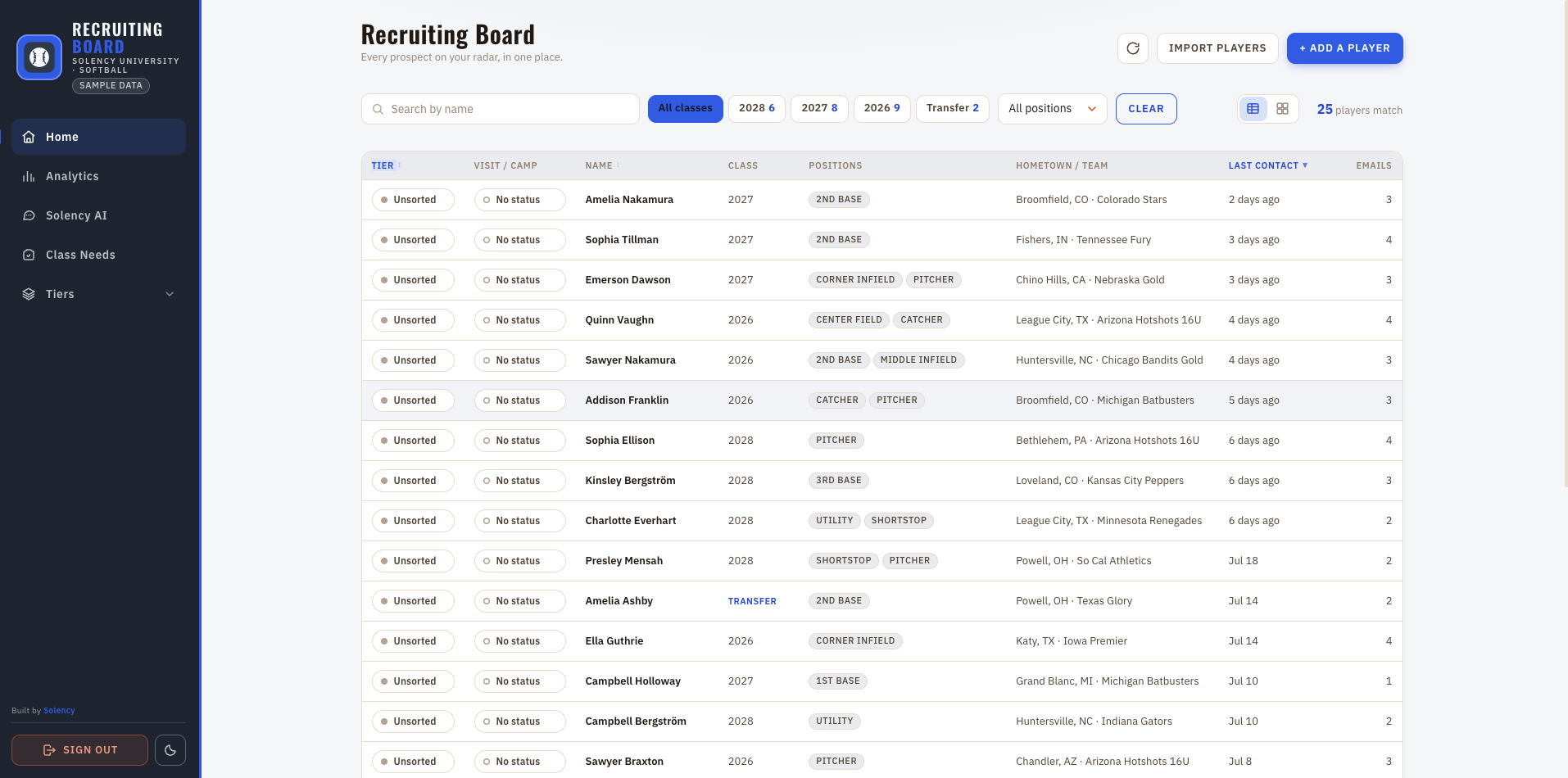
The board. Every prospect in one sorted list — tier, visit status, class, positions, hometown and team, last contact.
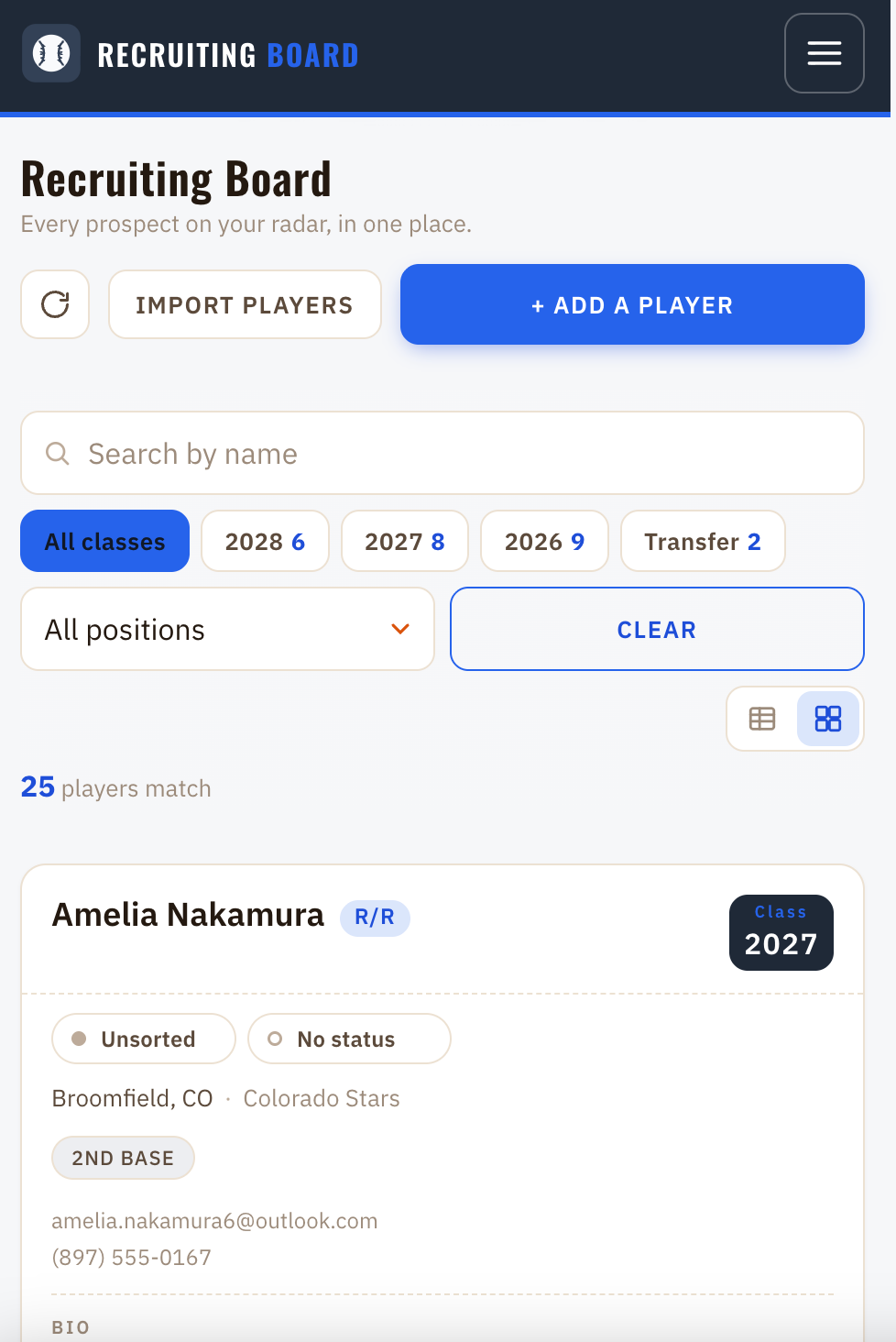
And on a phone. Same board, installable, no app store.
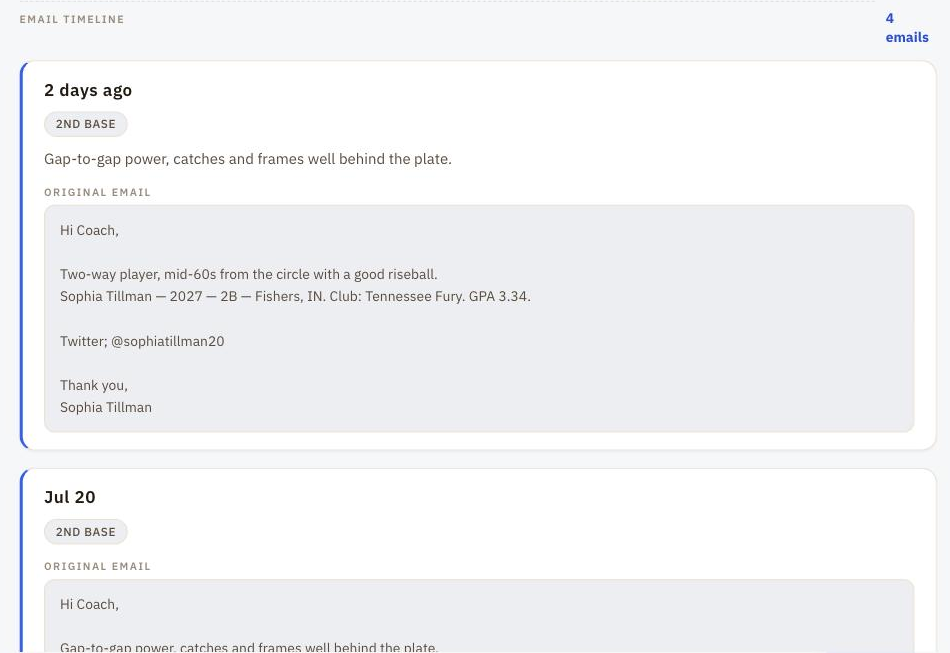
The player. Everything she and her people have ever sent, on one card.
Four emails from a player, her mother and her club coach become one prospect — not four rows. Contact details, class year, positions, hometown and travel team fill themselves in, and every film link she has ever sent stays attached to her, with the duplicates collapsed.
Her whole email history stays on the card, so you can read what she actually said before you call. Portal transfers get flagged as they arrive. Your notes sit alongside — and if you already keep a spreadsheet, it imports, so your existing list is on the board from day one.
Not a summary of them — the messages themselves, most recent first, with the original text kept word for word. The recruiting-service boilerplate and the tracking markup are stripped out; what’s left is what she actually wrote.
It is the thing you want ninety seconds before you pick up the phone, and it is the reason nobody on your staff has to remember a conversation they had in March.
No query builder, no saved filters to maintain. Type the thing you were going to ask your assistant and get it back off your own data.
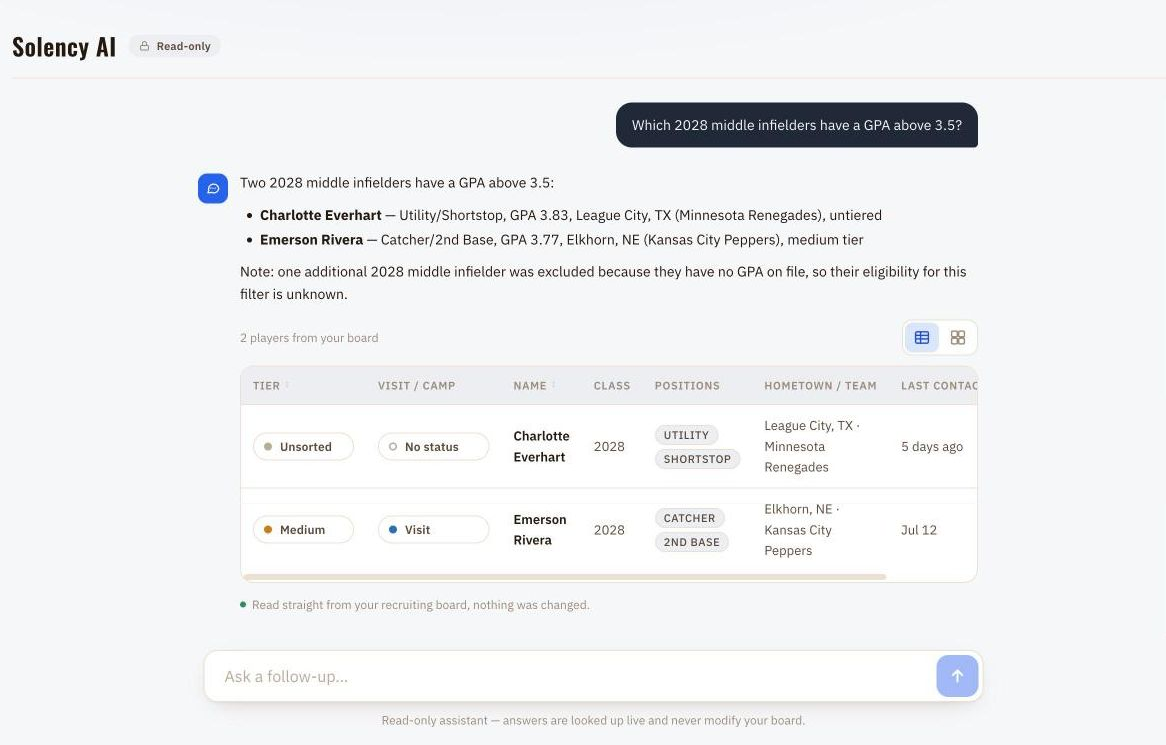
It cannot invent a playerThe players listed under an answer are rendered from the actual query result, not read out of the model’s text — so a name on screen is a row on your board or it isn’t there at all. And it only ever reads: nothing it does can change a tier, a note, or a prospect.
How many you’re tracking, how many are in the portal, how much mail actually came in, and where your classes and positions are thin. The shape of the recruiting year, without anybody building a pivot table.
Your own list of the gaps you’re recruiting to — class, position, priority, a line of context — ticked off as they fill. You write it and you close it; it’s a tracker sitting beside the board, not a matchmaker running against it.
Coach-assigned High / Medium / Low / No Chance, plus an Unsorted pile that’s the default view.
Visit · Visit + Camp · Camp Invite, editable inline beside tier.
Per-player notes log, kept beside her emails.
Drag-and-drop bulk import with header synonyms, a preview before anything writes, and duplicate detection.
Portal transfers detected at ingest, badged on the card, filterable on the board.
Search by name; filter by class, position, tier, slapper, portal.
Installable to the home screen, portrait-locked, pull-to-refresh, branded offline page. Never caches recruit data.
Viewer-persisted light/dark across the whole dashboard.
One shared program password. No per-seat pricing.
Links de-duplicated across tracking-token variants and click-tracker wrappers, then split into Social and Film / Links.
Each email is classified and mined for name, email, phone, class year, positions, hometown, travel team, GPA, bats/throws, tournament, bio and links.
Add a player by hand with duplicate-name protection.
Built for — and running live at — a Division I softball program through a full recruiting cycle. On that board: 4,000 recruiting emails read and sorted into 1,500 tracked prospects. Measured, not projected.
Encrypted in transit and at rest, access-controlled, scoped so your program only ever sees your own data. Encrypted off-site backups with a restore process we rehearse against real backups — worst case you lose a day of notes, not your board.
If it isn’t earning its place on your staff’s screens in the first month, email us and we refund it in full. No auto-renewal surprises either — we email you 30 days before the year is up.
One flat price for the whole staff — no per-seat, no per-prospect.
Fifteen minutes on a call, or open the live demo right now with the password on this page. Either way you see your own inbox’s shape before you decide anything.